
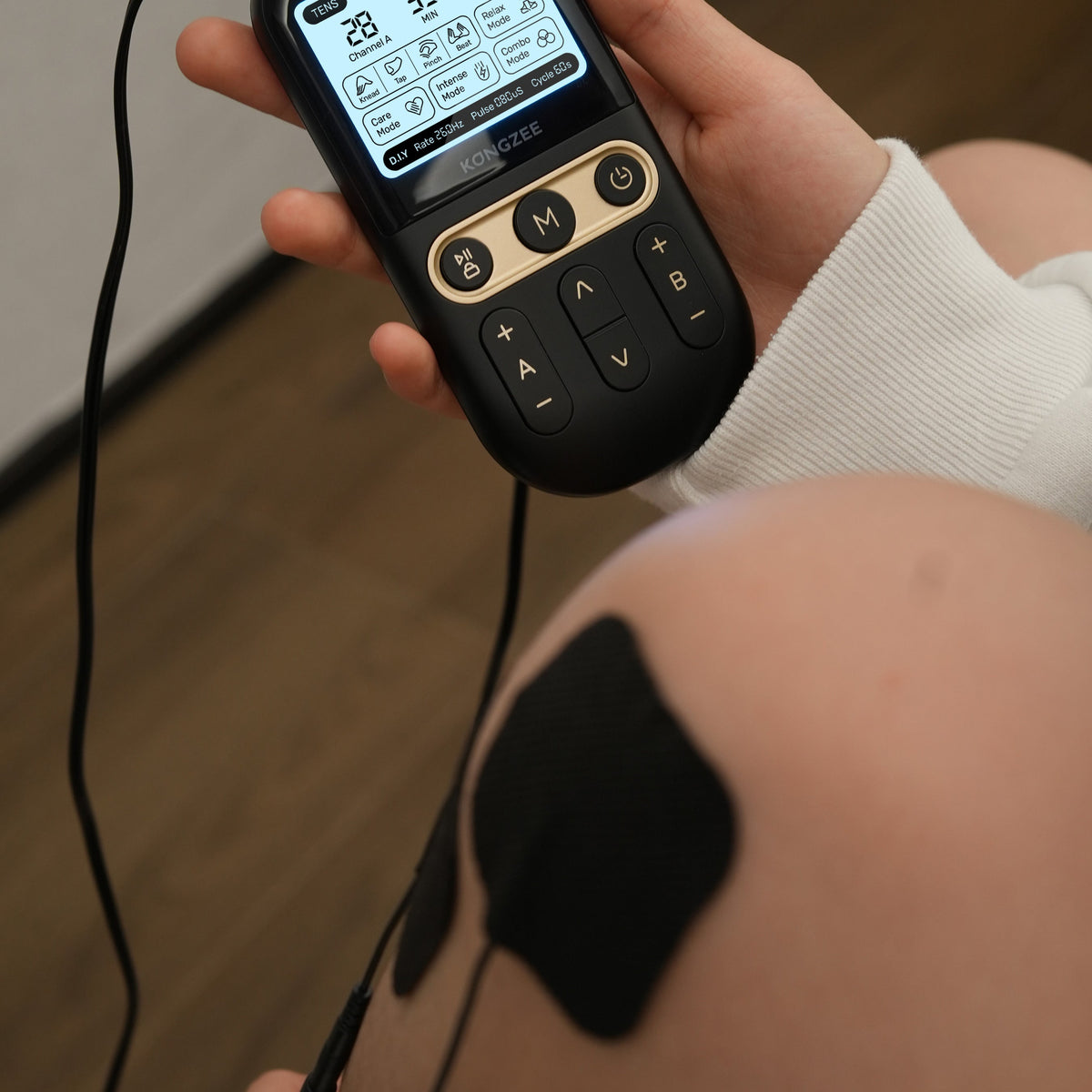
Short answer: A TENS unit does not directly “loosen” or strengthen a muscle. TENS is primarily used for sensory stimulation and temporary pain modulation. Some people may feel less tense when discomfort changes, but the response varies and research does not support a guaranteed muscle-relaxation effect or a fixed time to relief. EMS/NMES is different: it is designed to produce muscle contractions.
What a TENS Unit Actually Does
TENS delivers low-voltage electrical pulses through pads on the skin. The sensation is usually described as tingling. Proposed explanations include changing the transmission or perception of pain signals, but the exact experience and benefit vary. The NHS says TENS may provide temporary pain relief for some people and does not work for everyone.
The Cochrane overview of TENS for chronic pain found that available studies were too small and low in quality to support confident conclusions about effectiveness. It is therefore more accurate to describe TENS as a symptom-management option than as a proven muscle relaxer.
Why Muscles May Feel Less Tight After TENS
Pain and muscle guarding can occur together. If a person experiences a change in discomfort during TENS, movement may feel easier and the area may feel less tense. That is a subjective response; it does not show that TENS stretched the tissue, repaired an injury, increased circulation or corrected the reason the muscle felt tight.
Persistent tightness can have many causes, including overuse, reduced movement, stress, injury or an underlying condition. TENS should not replace assessment when symptoms are severe, unexplained or worsening.
TENS vs EMS for Muscles
| Question | TENS | EMS/NMES |
|---|---|---|
| Primary purpose | Sensory stimulation used for pain modulation | Motor stimulation intended to create muscle contraction |
| What should you feel? | Strong but comfortable tingling | Visible or felt contraction, depending on the program and guidance |
| Does it strengthen muscle? | Not its purpose | May be used in rehabilitation or conditioning plans |
| Can results be guaranteed? | No; response varies | No; appropriate use depends on goals and health status |
Cleveland Clinic’s electrical stimulation overview explains that stimulation therapies can target sensory or motor nerves for different purposes. Read our complete TENS vs EMS guide before selecting a mode.
How to Use TENS More Safely
- Read the instructions for your specific unit and electrodes.
- Switch the device off before applying, removing or repositioning pads.
- Use clean, dry, intact skin and keep pads separated.
- Begin at the lowest intensity and increase gradually to a strong but comfortable tingling.
- Stop if you feel burning, sharp pain, worsening symptoms or significant skin irritation.
Never place pads on the head, front or sides of the neck, broken or numb skin, or in a pattern that sends current across the chest. Do not use TENS while sleeping, bathing, driving or operating machinery. Ask a healthcare professional before use if you are pregnant or have a pacemaker or another implanted electronic device, epilepsy, heart disease, cancer, circulation problems or reduced sensation.
Using the KONGZEE 4-in-1 TENS & EMS Unit
The KONGZEE 4-in-1 DIY TENS & EMS Unit includes separate TENS, EMS, Massage and DIY modes, dual-channel independent intensity control and 40 intensity levels. Choose the mode according to its intended purpose and follow the manual. Do not assume that a stronger setting or visible contraction is better.
For general placement guidance, see the TENS unit pad placement chart. For contraindications and areas to avoid, read who should not use TENS.
When Muscle Tightness Needs Professional Advice
Seek medical advice for new or severe tightness, symptoms after major injury, progressive weakness or numbness, fever, unexplained swelling, chest pain, difficulty breathing, or symptoms that repeatedly return. A clinician can help determine whether the issue is muscular, neurological, circulatory or something else.
Frequently Asked Questions
Does TENS make muscles relax?
Some users report that an area feels less tense when discomfort changes, but TENS does not directly stretch or “release” muscle tissue, and a relaxation effect is not guaranteed.
How quickly should TENS work?
There is no evidence-based universal time. Some people feel a change during use, some afterward and some not at all. Follow the device manual rather than chasing a fixed number of minutes.
Can TENS improve circulation or speed recovery?
Those outcomes should not be assumed. TENS is primarily used for sensory stimulation and temporary pain modulation; it is not a substitute for diagnosis, rehabilitation or medical treatment.
Can I put TENS pads on my neck?
Never place electrodes on the front or sides of the neck. Shoulder or upper-back placement should stay on appropriate muscular areas and must not direct current across the chest. Ask a healthcare professional for individualized guidance.
Can TENS fix the cause of recurring muscle tension?
No. It may be one symptom-management tool, but posture, workload, injury, sleep, stress and medical conditions may require different approaches.
Sources
- NHS: Transcutaneous electrical nerve stimulation (TENS)
- Cochrane: TENS for chronic pain
- Cleveland Clinic: TENS
- Cleveland Clinic: Functional electrical stimulation
Reviewed July 28, 2026. This article is educational and does not replace medical advice, diagnosis or treatment.





Leave a comment
All comments are moderated before being published.
This site is protected by hCaptcha and the hCaptcha Privacy Policy and Terms of Service apply.